When your child is newly diagnosed with autism, one of the first major decisions you’ll face is where to begin therapy. For many families, Applied Behavior Analysis (ABA) is recommended as an evidence-based approach to help children build communication, social, and learning skills.
But as you start researching, you’ll quickly realize something: not all ABA programs are the same.
Some offer in-home therapy, while others provide center-based programs designed for early learners. Both can be effective but quality, philosophy, and experience vary widely. Choosing the right provider isn’t about finding the first one with availability; it’s about finding the one that’s right for your child and family.
This guide will help you know what to ask, what to look for, and what red flags to avoid so you can make an informed, confident decision.
1. Accreditation and Clinical Oversight
Accreditation is one of the strongest indicators that an ABA program meets rigorous standards of care and ethics. In the U.S., the Autism Centers of Quality (ACQ) is widely recognized as the highest standard of accreditation for autism service providers.
Earning ACQ accreditation means a provider has undergone a detailed external review, evaluating everything from treatment outcomes and supervision to staff training, safety, and family satisfaction. Only a small percentage of ABA providers hold this distinction.
Ask:
- Is your center ACQ-accredited or working toward it?
- Who oversees my child’s treatment plan: a Board-Certified Behavior Analyst (BCBA) or another credentialed clinician?
- How often will my child’s program be reviewed and updated?
Look for: organizations that clearly describe their accreditation process and oversight model and that are proud to meet measurable quality standards.
Red flag: vague answers, unfamiliarity with ACQ, or reluctance to share outcome data.
Dig in further: How to Choose the Right ABA Therapy Provider offers more on evaluating credentials.
2. Staff Training, Supervision, and Retention
Your child’s therapy team typically includes two key roles:
- A Board-Certified Behavior Analyst (BCBA): who designs and oversees your child’s individualized program.
- A Registered Behavior Technician (RBT): who works directly with your child each day to put that plan into action.
In a high-quality ABA program, these two roles are closely connected, not siloed. Every family should have a dedicated BCBA who is deeply involved in their child’s day-to-day progress, provides hands-on training to RBTs, and is accessible for regular communication.
Ask:
- Will a BCBA be assigned specifically to my child?
- How often will I meet or speak 1:1 with them?
- How do they support and train the RBT working with my child?
- Do they take time to understand our family values and which goals are most meaningful?
- Are they flexible and willing to meet our family and child where we are?
Look for: programs where BCBAs observe sessions regularly, meet with parents often, and coach therapists directly. That collaboration keeps therapy individualized and effective.
Tip: Ask how new RBTs are trained, how feedback is given, and how supervision works week-to-week. A strong BCBA–RBT partnership ensures quality and prevents turnover, creating stability for your child.
Red flag: limited BCBA access, infrequent supervision, or uncertainty about who your main point of contact is.
3. Individualized, Data-Driven Care
Every child with autism is unique, and therapy should reflect that. Strong ABA programs build individualized plans based on assessments, then adjust those plans using daily data collection.
Ask:
- How are my child’s goals created and updated?
- How do you involve families in goal-setting?
- How frequently do you review progress data?
Look for: a provider who welcomes your input and can show objective progress tracking.
Red flag: identical lesson plans for all children or vague progress reports.
4. Staff-to-Child Ratios
For early learners (ages 2–6), individualized attention is key. Many high-quality programs maintain 1:1 support for intensive instruction and introduce small-group sessions for social learning.
Ask:
- What’s your typical staff-to-child ratio?
- How are groups supervised during transitions or play?
Low ratios promote consistent learning, safety, and meaningful connections.
5. Environment and Learning Space
Children thrive in spaces that feel safe, cheerful, and structured. When possible, visit the center in person to see how it feels.
Ask:
- What does a typical day look like here?
- Do you have outdoor or sensory-friendly spaces?
- How do you balance structured teaching with play?
Look for: organized, bright, and welcoming spaces where children and staff seem happy.
Explore how schedule length affects progress in Full-Day vs. Partial-Day ABA Therapy.
6. Collaboration with Schools and Other Providers
The best ABA programs treat therapy as part of a larger system of support. Your child’s team might include teachers, speech therapists, occupational therapists, or pediatricians.
Ask:
- How do you coordinate with my child’s other providers?
- Do you offer parent training or progress meetings?
Providers who take a whole-child approach ensure consistent strategies across home, school, and community settings.
7. Mission and Motivation
Behind every high-quality program is a clear “why.” Asking about an organization’s origins and philosophy can reveal a lot about its culture.
Ask:
- What inspired the creation of this organization?
- How do you define success for the children you serve?
Look for sincerity, empathy, and alignment with your family’s values.
8. Waitlists and Accessibility
Demand for ABA therapy is high, so availability varies. Transparency about timelines and intake processes is a good sign.
Ask:
- How long is your waitlist?
- How do you prioritize families?
- Are resources available while we wait?
If you’re still awaiting a diagnosis or starting the process, see Why Seeking an Autism Evaluation Early Matters.
9. Additional Practical Considerations
Beyond credentials and ratios, a few other factors can make a major difference:
- Therapy hours: Does the center offer full-day or half-day options that fit your child’s needs? (See Full-Day vs. Partial-Day ABA Therapy.)
- Parent involvement: Are families encouraged to observe sessions, attend meetings, or receive training? (See How to Prepare for ABA Therapy.)
- Age focus: Programs built for early learners (ages 2–6) often provide the most comprehensive, center-based models.
- Atmosphere: Does the clinic feel calm, joyful, and child-centered?
10. Outcomes That Matter
Not all ABA programs measure outcomes in the same way or share them transparently. Yet outcomes are what matter most: real, measurable progress toward your child’s goals.
Ask:
- How do you define and track progress?
- Do you measure developmental gains against national benchmarks?
- How often do you share outcome data with families?
Look for: providers who not only collect data but also evaluate it over time to ensure your child is truly learning and thriving. Transparent outcome reporting signals accountability and confidence in their clinical model.
For context, Stride’s results significantly outperform national averages:
- Stride children achieve 100% greater gains under moderate-intensity ABA and 80% greater gains under high-intensity ABA compared with CASP (the national industry benchmark).
- 94% of parents report meaningful improvement in their child’s ability to initiate communication, one of the most important early-childhood milestones.
Red flag: vague answers about outcomes, or a reluctance to share data. Meaningful progress should be visible and celebrated.
11. Specialization and Focus
Some providers offer every service under the sun, from in-home sessions to teen programs. Breadth isn’t always a sign of quality. In fact, specialization often drives better outcomes, especially for young children learning foundational skills.
Ask:
- What age group or population do you specialize in?
- How does your program design reflect that focus?
- Do you tailor your environment and teaching methods for early learners?
Look for: a provider whose expertise clearly aligns with your child’s developmental stage. For example, if you know center-based ABA for preschoolers is the right fit, seek out a program built specifically for that model, where staff, curriculum, and environment are all optimized for early learning.
Red flag: programs that serve “all ages and needs” without clear specialization. The best providers know who they serve best and structure everything around that.
12. Create a Comparison Scorecard
As you visit or interview providers, track what you learn. A simple chart can help:
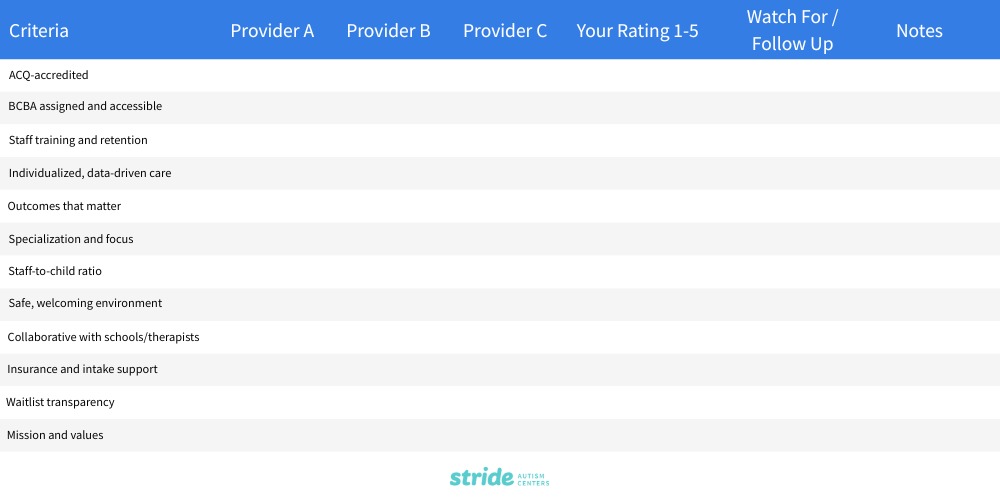
Seeing everything side by side can turn an emotional decision into an informed one and help you choose a program that truly aligns with your child’s needs and your family’s values.
Final Thoughts
Choosing an ABA provider is one of the most meaningful decisions your family will make. The right fit combines clinical excellence, compassionate care, and transparency where your child is known as an individual and progress is both measured and celebrated.
Visit several programs, ask questions, and trust your instincts. The best ABA centers make that trust easy to feel.
For more guidance on evaluating options and preparing for therapy, you may also enjoy:
Finally, spend time on Google reviews to see what actual customers (families) say about their experience and if/how their child met their goals. The best source of information is always other families.