As a parent, you would love to give the perfect gift that lights up your kiddo’s face. Finding holiday gifts for children with autism involves considering their specific needs for predictability, routine, and sensory comfort, rather than traditional, overwhelming holiday experiences.
This quick guide for busy parents has been expertly curated to make holiday shopping joyful and stress-free.
Gifts for Calm and Comfort During the Holidays
The holiday season can be overwhelming for children with autism. Common stressors include changes to routines, large crowds, new foods, and the unpredictability of social gatherings. The rhyming picture book, “Too Much! An Overwhelming Day,” is a perfect starting point for your little one’s festive season: “When feelings go on overload, I pause and breathe, and all is… slowed.”
Weighted Items for Security
Weighted items provide deep pressure, mimicking a hug and calming the nervous system for children with autism spectrum disorder. This deep touch regulates stress, promotes relaxation, reduces anxiety, and improves focus. The pressure helps children feel secure.
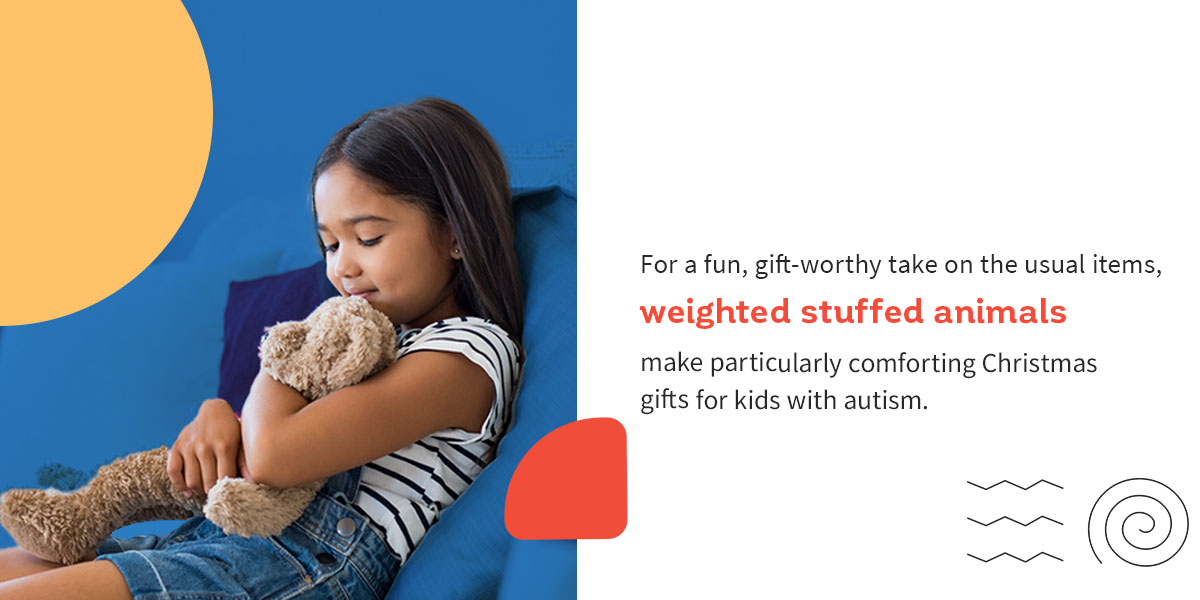
For a fun, gift-worthy take on the usual items, weighted stuffed animals make particularly comforting Christmas gifts for kids with autism. If you can’t make up your mind between Pookie the Panda and Sunnie the Sloth, consider ordering a family pack so your kiddo always has one nearby.
Keep safety and supervision in mind when using weighted items, and consult with your child’s clinic team for specific weight guidance.
Personal Sensory Retreats
Even adults need a quiet place where they can retreat from all the noise and bustle of the festive season. It is especially important for children with autism to have a calm space at this busy time to avoid sensory overload from the increased activity and stimulation. A solitary designated area becomes a safe haven for them to decompress, recharge, and feel strong, even when things feel overwhelming.
A sensory tent of their own is one of the best holiday gifts for children with autism — a space where they can feel a sense of control over their environment. Most are easy to set up and may come with comfort-enhancing features like mesh storage and straps for fidget toys or escape holes so your child never feels trapped. Some even have a single-button light, allowing your kiddo to feel in control of the space.
Presents That Build Skills Through Play
There is a wide selection of toys that are so much fun, your kiddo won’t even realize they’re developing crucial skills. Use your child’s interests to structure activities and combine different types of play, like sensory, pretend, and cause-and-effect games. This helps develop foundational, cognitive, social, and motor skills by providing a safe and engaging environment to practice new abilities at their own pace.
Fine Motor Skill Toys
Fine motor toys can improve hand-eye coordination, finger strength, and dexterity through engaging, hands-on activities. They also support cognitive skills like problem-solving and spatial awareness, and can build confidence and independence by breaking down complex tasks into manageable, fun steps.
Two exciting examples are magnetic building blocks and threading boards. Kids love magnetic blocks because they provide a fun, open-ended way to be creative, explore, and build things.
For kids 3 and up, threading boards help strengthen grip, improve coordination and motor planning, and build concentration and self-regulation. Lacing and threading toys are a beautiful addition to any selection of holiday gifts for children with autism.
Oral, Motor, and Chewable Tools
Oral, motor, and chewable toys can encourage sensory regulation by providing calming oral input and strengthening the oral motor skills needed for speech and eating. These toys also have the potential to build concentration skills.
A discreet chewable necklace and textured fidget pencil toppers or grips are popular examples of sensory-friendly gifts for children.
If you’re looking for additional options, explore seven of the best chewie toys for children with autism.
Gifts to Encourage Social Connection
Family gatherings offer opportunities for connection and celebration, but your kiddo may find these events challenging. Thoughtful planning and understanding make gatherings enjoyable and inclusive for all. There are toys that can help.
Cooperative Board Games
Cooperative board games offer a structured environment to practice social skills like communication, turn-taking, and emotional regulation in a low-pressure setting. Encouraging teamwork toward a shared goal can reduce the anxiety of competition and help children develop cognitive abilities like problem-solving and decision-making without the fear of losing individually.
One of the best gifts for a child with autism that encourages bonding and communication is “Do You Know Your Peeps?” and the “Social Skills” collection of six board games.
Role-Playing and Imagination Sets
Role-playing helps preschoolers with autism by providing a safe and structured way to practice crucial social and communication skills. This includes interpreting social cues, engaging in conversations, and navigating social situations. It also helps them develop flexibility in thinking and behavior, build confidence, and improve their language development as they practice social scripts through play.
Play sets are a fun way to get into role-playing. Scenarios can include preparing a meal in a make-believe kitchen or visiting a veterinarian’s office. This is also a great way to prepare your little one for visits to the doctor, the grocery store, or their first hiking trip.
How to Choose a Gift Your Kiddo Will Love
Use this quick and easy checklist to help you choose the perfect gifts for your child this festive season:
- Observe their current passions and the toys or objects that hold their attention.
- Select gifts that build on the child’s strengths and think about a “just-right” challenge — a toy that encourages growth without causing frustration.
- Consider whether they are sensory-seeking or sensory-avoiding.
- Pick sensory-friendly items, like soft, tag-free clothing or calming textures.
- Avoid gifts with loud noises, flashing lights, or overstimulating features.
- Check for potential safety risks, like choking hazards.
- Don’t be afraid to ask for a list or ideas from your kiddo or their therapists.
Give the Lasting Gift of Confidence and Growth
While your kiddo’s enthusiasm for their favorite toy may dim over time, developmental support is a gift that will last them a lifetime.
ABA therapy is the evidence-based approach that incorporates structured play to build foundational skills. This can lead to improvements in cognitive abilities, social skills, and communication. Starting early, especially between ages 2 and 6, is crucial because the brain is highly adaptable. ABA therapy works by breaking down complex behaviors into smaller steps and using positive reinforcement to help your little one learn new skills that will help them thrive.
Stride Autism Centers in Illinois, Iowa, and Nebraska offer ABA therapy for children aged 2 through 6 and their families. Contact our dedicated team by calling 515-207-5251 today to learn more about how our programs can be tailored to your child’s unique needs.